


Blog
How a Potentiometer Works ?

How Potentiometer operates
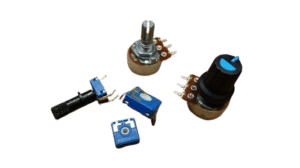
A potentiometer, commonly known as a pot, exists in various shapes and finds applications in numerous aspects of daily life. One such instance is its use in regulating the audio volume of a radio.
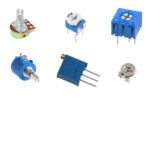
A pot is a manually adjustable variable resistor with three terminals. In the figure below you can see some examples of potentiometers.
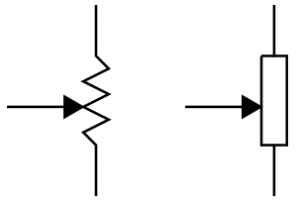
In a circuit diagram, one of the two symbols below represents a potentiometer:
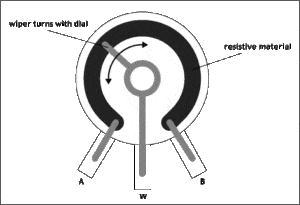
A potentiometer has 3 pins. Two terminals (the blue and green) connect to a resistive element, and the third terminal (the black one) connects to an adjustable wiper.
Potentiometers function as voltage dividers. To use the potentiometer in this capacity, connect all three pins. One outer pin links to GND, the other to Vcc, and the middle pin serves as the voltage output.
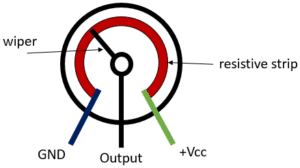
In the role of a voltage divider, the position of the wiper controls the output voltage of a potentiometer. In this setup, the connected potentiometer gives rise to the subsequent circuit.
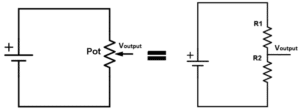
Essentially, the voltage divider serves the purpose of converting a higher voltage into a lower one.
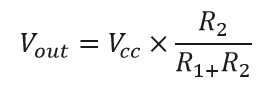
The output voltage can be calculated using the Ohm’s Law-derived equation:
Potentiometer Types
There are two main types of potentiometers:
- Rotary potentiometer
- Linear potentiometer
The basic constructional features of these potentiometers may vary, but the operational principle remains consistent for both types.
Highlighting that these references apply to DC potentiometers, the configurations for AC potentiometers display some differences.
What are the advantages and disadvantages of Potentiometer
Here are the strengths and weaknesses of a potentiometer:
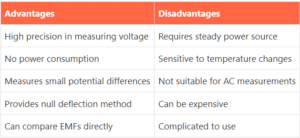
Advantages
- High precision in measuring voltage– A potentiometer offers high precision in measuring voltage, which means it gives very accurate results. This makes it a reliable tool for electrical measurements.
- Zero power consumption: Potentiometers operate without consuming power, showcasing their energy efficiency and cost-effectiveness.
- Measures small potential differences– They are capable of measuring very small potential differences. This capability aids in detecting subtle changes in voltage that might be overlooked by other devices.
- Provides null deflection method– Potentiometers use a null deflection method for measurement. This means they measure without causing any disturbance in the circuit.
- Can compare EMFs directly– They can directly compare electromotive forces (EMFs) of two cells. This direct comparison provides more accurate and reliable results.
Disadvantages
- Requires steady power source– Potentiometers need a constant power supply to function accurately, meaning they won’t work properly if the power source fluctuates or is inconsistent.
- Sensitive to temperature changes– Changes in temperature can affect their performance, making them less reliable in environments with varying temperatures.
- Not suitable for AC measurements– They are not designed to measure alternating current (AC), limiting their use in certain electrical applications.
- High costs: High costs can pose a challenge for certain users when it comes to potentiometers, especially when dealing with larger quantities or precision models.
- Complicated to use– Using potentiometers can be complex, requiring technical knowledge, which can make them difficult for beginners or non-experts to use.

 Boards & Modules
 ARM Microcontroller
 AVR Microcontroller Board
 Arduino boards
 Advance Development Boards
 8051 Development Board
 Audio Amplifier Module
 Current & Volatage Sensor
 Breakout Board
 Flame Sensors
 Force Sensor
 Gas Sensors
 Hall Effect Sensor
 Humidity & Temperature Sensor
 LED Module
 PIR Sensor
 Pressure Sensors
 Proximity Sensor
 Relay Module
 Real Time Clock (RTC) Module
 Touch Sensor
 Ultrasonic Sensor
 Water Level & Water Flow Sensor
 Weighing Scale Sensor







 Ai Thinker ESp Wifi Module
 Pic Devlopment Board & programmer
 Led lights & Strips
 PCBs & Breadboard
 Potentiometer
 Power Transistors
 Resistor & Smd & inductor
 Switches
 Aluminium Heat Sink
 Buzzer & Speaker
 capacitor
 Crystal Oscillators
 Doides
 Electric Fuses
 ICs & Dips
 Power supply module
 Transformer
 Relay Module
 Kits
Kits Magnet
 RF Connectors
 PCT and DC Connectors
 Wires & Heat Shrink
 FFC, FPC, Berg connectors
 Nextion
 Segment
 Seedstudio
 Waveshare
 E Bike Batteries
 E bike Battery Case
 E bike Connectors
 E bike Display
 E bike Kit
 E bike Motors & Controllers
 Electronics Accessories
 Mechanical Accessories
 Display
 Cameras